What Gets Into Bread, and What X-ray Can Catch
Foreign material is behind roughly one in nine recalls of bakery products in the United States: 86 FDA recalls between 2016 and 2025, about one every six weeks on average, according to Mekitec's analysis of FDA and EU data. Metal or plastic is named in about 7 of 10, and about 1 in 8 was traced to an ingredient. In the European Union, the Rapid Alert System for Food and Feed (RASFF) logged 94 foreign-body notifications on bakery products from January 2020 to 9 November 2026, with metal in about half.
This guide explains where foreign material (also called foreign bodies, foreign objects or physical contaminants) comes from in a bakery, what an X-ray system can find in bread, buns and biscuits and what it cannot, how it compares with a metal detector, where on the line to inspect, and what else the same X-ray image can check.
The short answer
- How often: about 1 in 9 US bakery recalls (FDA, 2016 to 2025) is for foreign material, and in Europe RASFF lists 94 foreign-body notifications on bakery products since 2020; metal is named most often in both.
- What X-ray finds: materials much denser than the product, such as metal, glass, stone, bone and dense plastics, depending on their size and on the product.
- What X-ray usually misses: wood, paper, soft and thin plastics, hair, insects and thin aluminium foil. Sieves, magnets and supplier controls stay essential.
- Metal detector or X-ray: a metal detector can be enough when metal is the only hard hazard and the product and pack suit it; X-ray is the stronger choice for glass, stone or dense plastic, for foil or metallised packs, and when you also want to count or measure. BRCGS, IFS and the US preventive controls rule do not require X-ray, but the choice has to be justified.
- More than safety: the same image can count pieces, measure shape and size, and find holes or missing filling.
- Your product: the reliable answer comes from a test on your own bread, buns or biscuits in their real packs.
Go straight to what you need:
- How often is foreign material found in bakery products?
- What can X-ray detect in bread, and what can it miss?
- Metal detector, X-ray or both?
- Should bread be inspected before or after bagging?
- What else can the X-ray image check in a bakery?
How often is foreign material found in bakery products?
Every year: from 2016 to 2025, between 4 and 16 US bakery recalls a year were for foreign material, about 1 in 9 of all bakery recalls, with metal and plastic named most often.
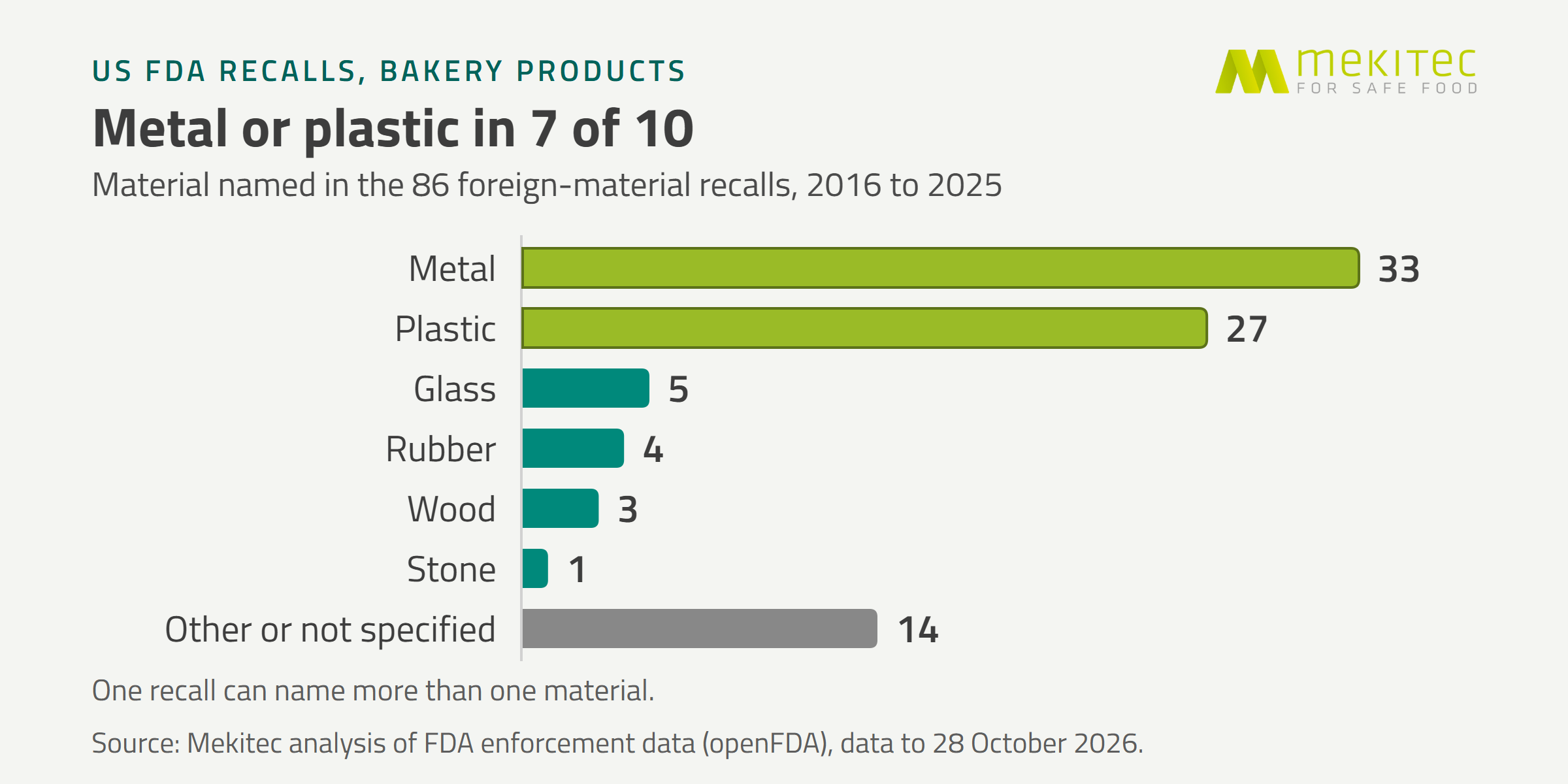
- What: metal in 33 of the 86 recalls and plastic in 27, then glass, rubber, wood and stone. The EU's 94 notifications show the same order: metal, plastic, glass.
- How serious: none was FDA Class I, the class for a reasonable probability of serious adverse health consequences or death; 84 were Class II, for temporary or medically reversible harm or a remote chance of serious harm. Each recall still means product destroyed, customers informed and a cause to find.
- Compared with other foods: foreign material was behind 11.6% of US bakery recalls against 10.1% of all food recalls, so bakery sits close to the average.
The year-by-year figures, the method and the data files are on the bakery recall data page.
Where does foreign material in bakery products come from?
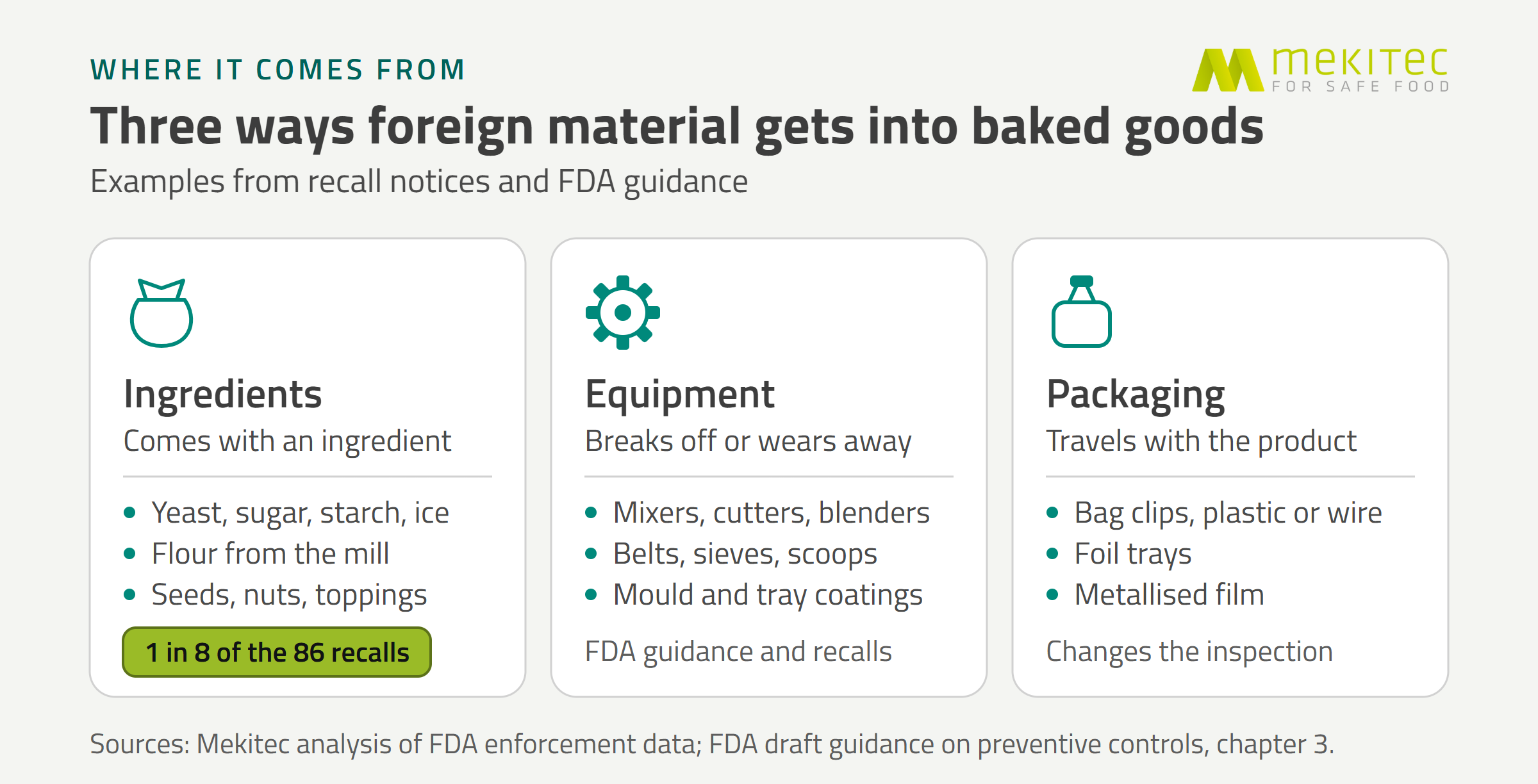
From three places: the ingredients, the line itself and the pack.
Ingredients
In 11 of the 86 US bakery recalls for foreign material, about 1 in 8, the material came in with an ingredient or an ingredient system: a supplier's yeast, a sugar topping, starch, ice, a palm-oil silo. In 2026 a US food manufacturer recalled more than 23,000 cases of focaccia after metal fragments were traced to roasted tomatoes from an ingredient supplier. In 2024 a US mill recalled bulk bread flour for possible metal, wood, gasket material and sifter balls. Toppings carry their own hazards: in 2025 a US supplier recalled bakery-grade sunflower kernels for glass fragments, and in 2023 two kinds of almond cookies were recalled for pieces of rock.
Equipment on the line
FDA names cutting and blending, wire-mesh belts, worn scoops and deteriorating plastic sieves among the typical sources of physical hazards (FDA draft guidance, chapter 3). The recall record bears this out: stainless steel fragments from a damaged dough mixer in bread (US, 2013), pieces of conveyor belt in frozen pizza dough sheets (US, 2024), fragments of a flaking baking-mould coating in pandoro (Italy, Spain, Canada and the US, 2026). Others name no source: a pallet nail found in a sourdough loaf (US, 2026) and a metal bolt in a frozen croissant (EU alert, 2025).
Packaging and closures
Bread bags close with plastic or wire clips, cakes travel in foil trays and biscuits in metallised film. None of these is usually the hazard itself, but each changes how a pack can be inspected, as the sections below explain.
What can X-ray detect in bread, and what can it miss?
An X-ray image shows how much X-ray each part of the pack absorbs, which depends on the thickness, density and composition of what the beam passes through. Bread crumb is about 80% air (Morren et al., 2016), so metal, glass and stone absorb far more than the bread around them and stand out. Wood, paper and most plastics absorb so little that they are lost in the texture of crumb and crust, even where they are denser than the crumb.
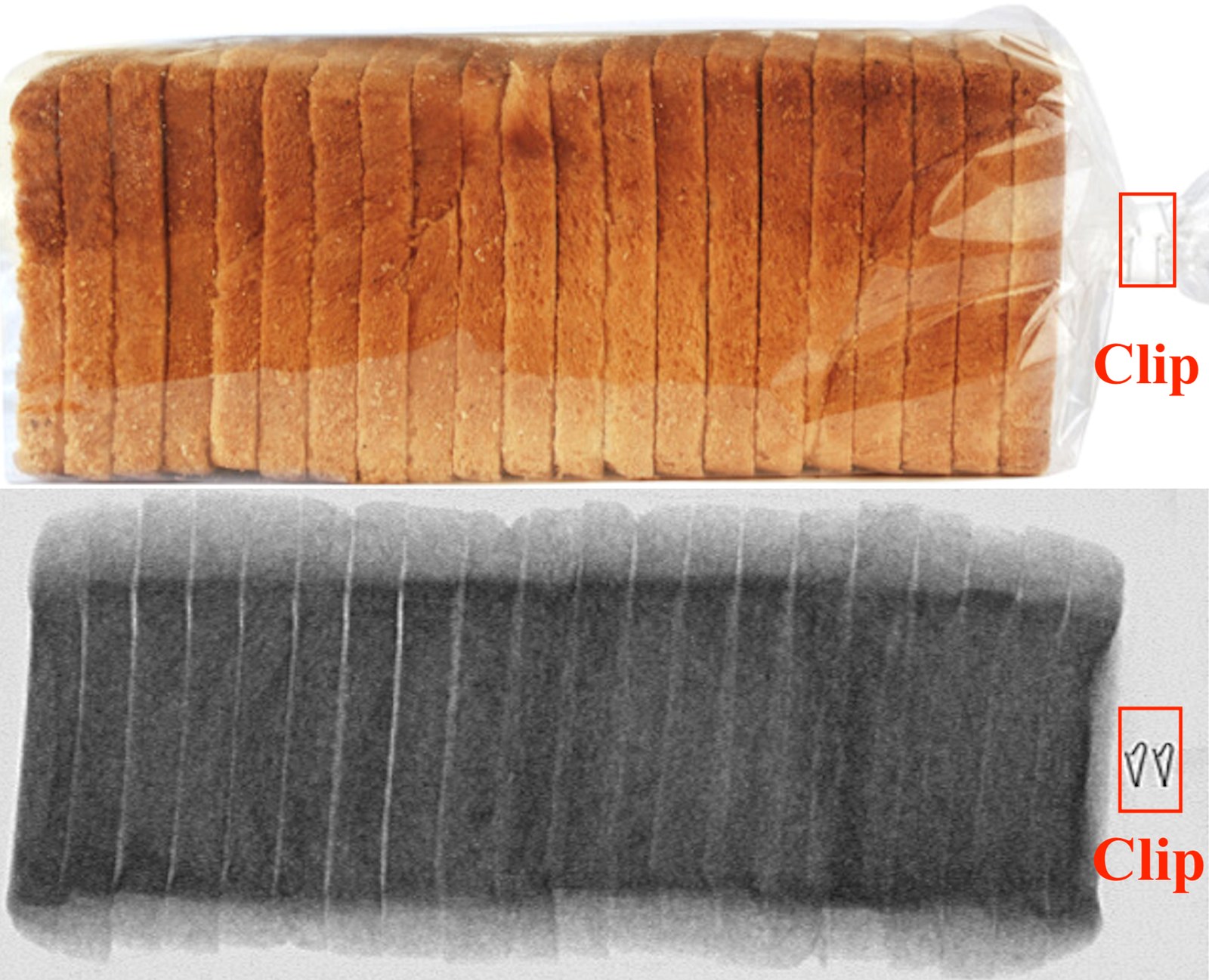
A sliced loaf in its bag, as a photo and as an X-ray image: the crumb shows as an uneven grey, the gaps between the slices as thin light lines, and the clip at the end of the bag stands out. Image: Mekitec.
The IFS guideline on foreign body management groups materials by density for foods that contain water (IFS FBM guideline, version 3). Bread is much lighter than water, so read the grouping as a guide:
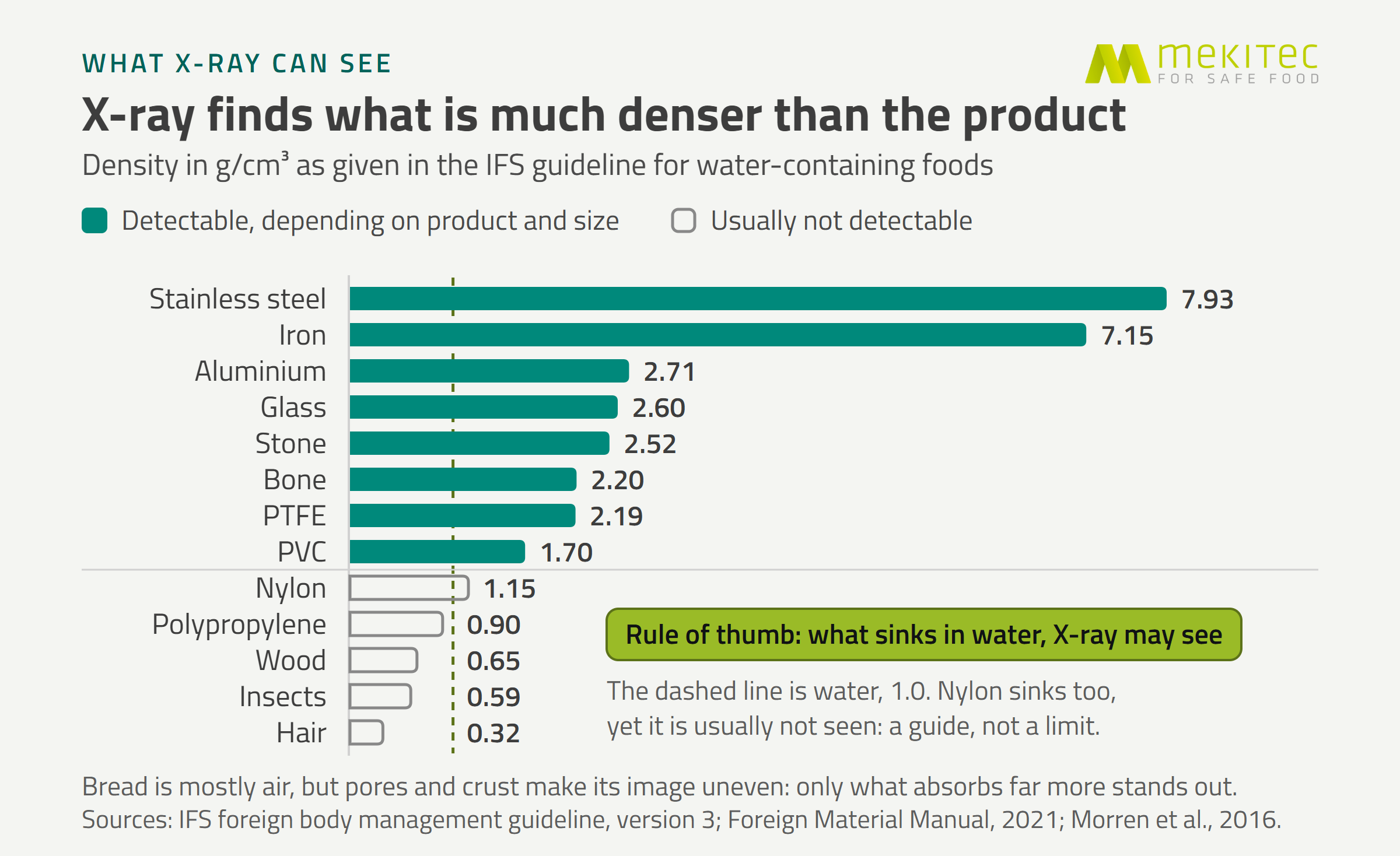
- Detectable, depending on product and size: stainless steel (7.93 g/cm³), iron (7.15), aluminium (2.71), glass (2.60), stone (2.52), bone (2.20), PTFE, the non-stick coating (2.19), PVC (1.70).
- Usually not detectable: nylon (1.15), polypropylene (0.90), wood (0.65), insects (0.59), hair (0.32).
A rule of thumb from the meat and poultry industry, for foods that are mostly water: if a fragment sinks in water, X-ray can potentially detect it (Meat and Poultry Industry Foreign Material Manual, 2021). The same IFS guideline gives typical X-ray detection sizes (sphere diameter) in plastic, paper or metallised-film packs: about 0.8 mm for metal, 2.0 mm for aluminium, glass and stone, and 3.5 mm for bone and dense plastic. These are generic values from the IFS guideline, not figures for a particular bread or system.
What X-ray does not see:
- Light or low-contrast materials: wood, paper, soft and thin plastics, hair, insects and nutshells are hard or impossible to see. Sieves, magnets, supplier approval and glass and plastics policies stay essential.
- Thin aluminium foil: usually invisible to X-ray, because it absorbs almost nothing. A metal detector usually finds foil fragments better, although a thin flake can give a weak signal depending on its size and orientation.
- Bread itself: pores, crust and changing thickness make the image of a loaf uneven, and IFS notes that detection works best in homogeneous products. This is why the inspection is set up and proven for each product, and why image analysis matters. An uneven product can also cause false rejects; the test on your product shows the balance between detection and false rejects.
Whether a given fragment is found in your product is a question for a test, not for a datasheet.
Ask for a test on your product
Tell us the product, the pack and the foreign materials in your hazard analysis, so we can agree what an application test needs to show.
Metal detector, X-ray or both?
Both can be right. A metal detector can be enough when metal is the only hard hazard in your hazard analysis and the product and pack suit it. X-ray is the stronger choice when the hazard analysis also names glass, stone or dense plastic, when products are packed in foil or metallised film, or when you also need to count or measure; some lines run both. Either way, the choice has to be documented and justified.
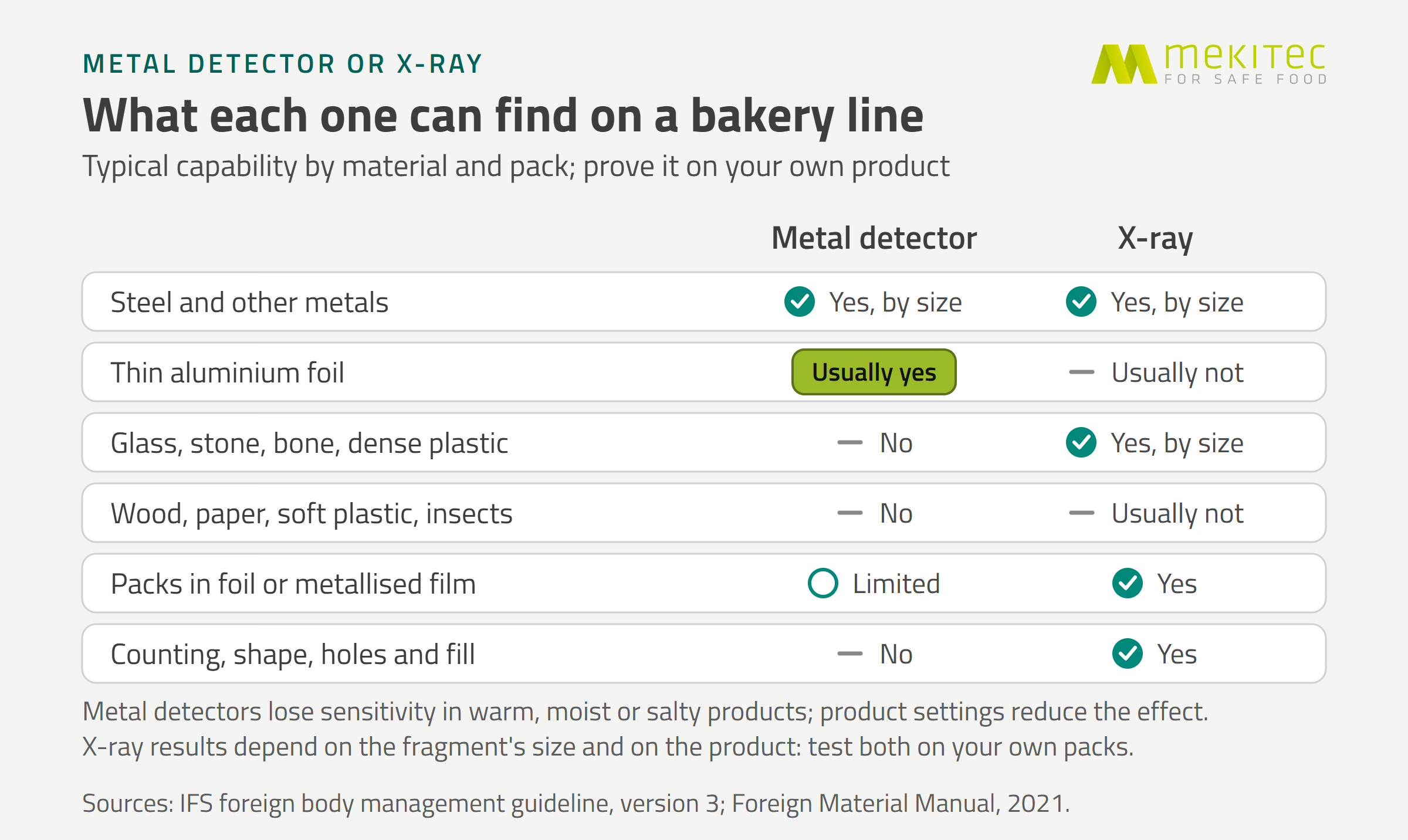
- When bakery products are hard for metal detectors: moisture, salt, temperature, size and packaging create a "product effect" that reduces sensitivity, and non-magnetic stainless steel is among the hardest metals for a metal detector to find (IFS FBM guideline, version 3; Foreign Material Manual, 2021). Product settings reduce the effect, but warm, moist or salty bread and filled cakes remain typical cases; dry biscuits and crackers give little product effect.
- Packs that limit metal detection: in foil trays a metal detector generally finds only ferrous metal, using a ferrous-in-foil detector, and metallised film reduces sensitivity on many detectors. X-ray can inspect through both. City Baking, a US bakery, moved to a MIDMEKI X-ray system in 2015 when its metal detectors could not inspect its larger and foil-packed products, and Snackwerks, which packs cookies and granola in metallised film, validated its three MEKI ONE systems with its own products in April 2026.
- Where a metal detector can be the better tool: aluminium foil fragments in a product without foil, and dry products in plastic film where metal is the only physical hazard in the hazard analysis. It also needs no radiation-safety registration or checks.
- Clips: an X-ray system can ignore the bag clip and still inspect the bag.
- What standards and buyers expect: none requires X-ray. BRCGS Food Safety Issue 9 expects metal detection unless a documented risk assessment justifies an alternative, IFS Food version 8 has no requirement for a specific detector, and the US preventive controls rule (21 CFR 117) requires a hazard analysis that covers physical hazards. Costco's food safety audit expectations for suppliers (version 3.0, effective 1 September 2025) ask for at least a metal detector, or an equivalent detector that works best for the product, justified with documented evidence, and challenge tests at least every two hours. Confirm the current requirements with your certification body and customers.
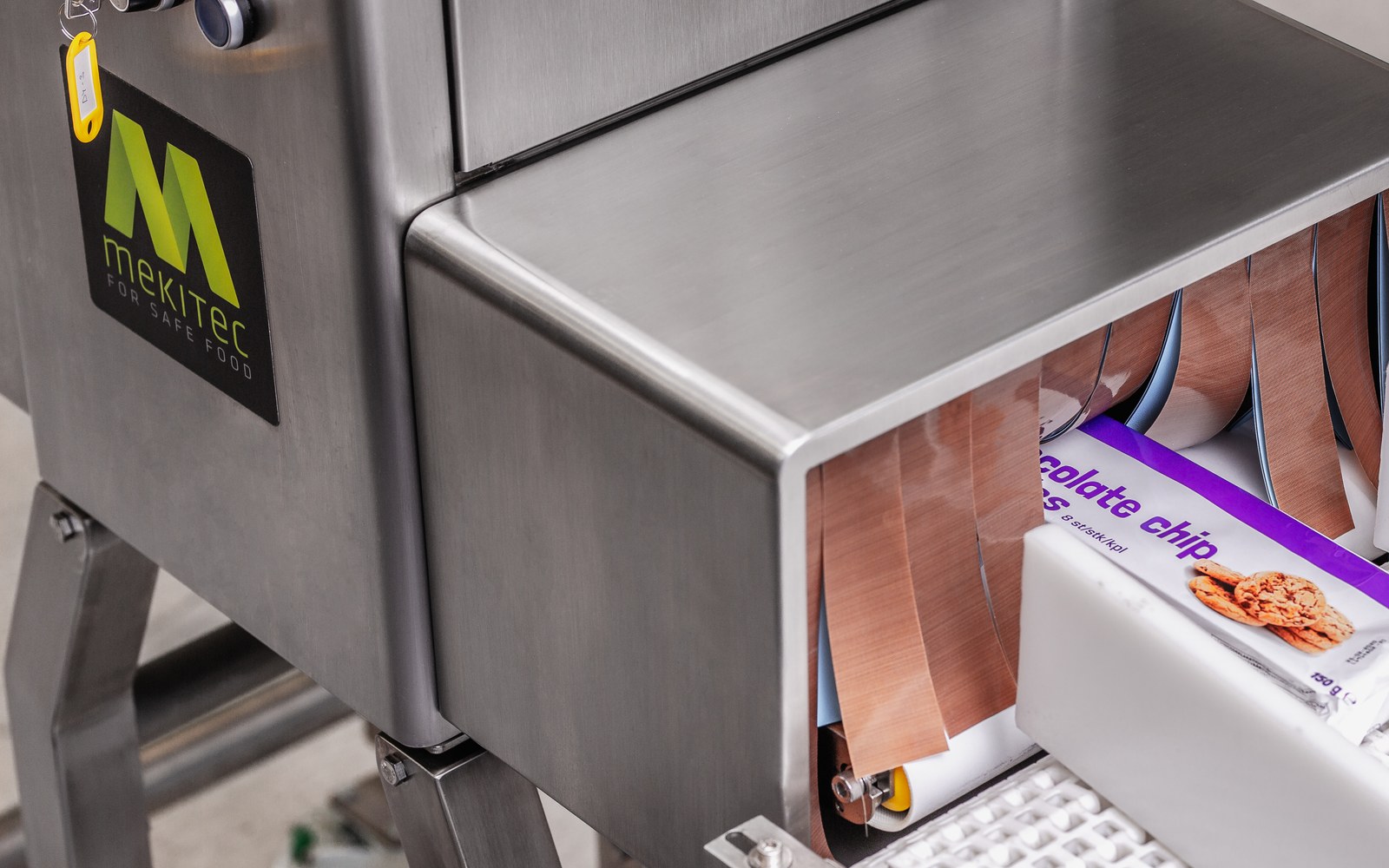
A pack of cookies enters the inspection tunnel of a MEKI X-ray system. Photo: Mekitec.
What decides it on a bakery line:
- Product: is it moist, salty, warm or uneven in thickness?
- Pack: foil, metallised film, a wire clip?
- Hazards: does your hazard analysis name glass, stone or dense plastic as well as metal?
- Quality: do you also need to count, measure or check fill?
- Position: before or after bagging, and what can enter the product after the check?
Should bread be inspected before or after bagging?
After bagging is the safer default, because it also covers the slicer and the bagger, the last points where something can get in. IFS Food version 8 asks for detectors to be installed so that nothing can contaminate the product afterwards. Inspecting before slicing can make sense as an extra check, or where the bagged product cannot be inspected well, provided the slicer and the bagger are controlled in another way.
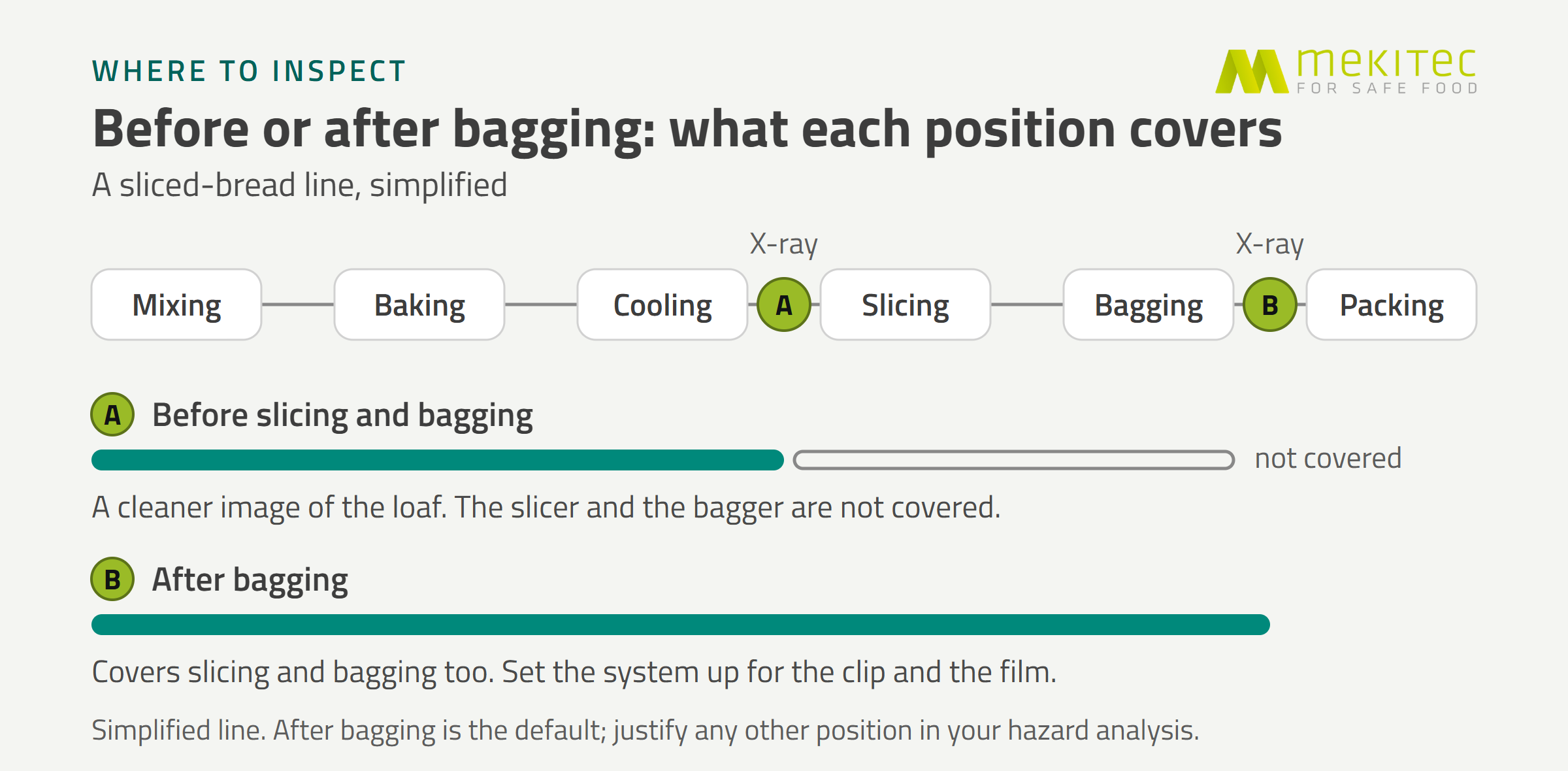
- After bagging: the check also covers anything that enters during slicing and bagging. The clip and the film appear in the image, so the system must be set up for them.
- Before slicing and bagging: the image of the loaf is cleaner, but the slicer and the bagger are not covered.
Whatever can enter the product after the check has to be controlled in another way.
What else can the X-ray image check in a bakery?
The same image can count pieces, measure shape and size, find holes and check fill, so a bakery can stop incomplete, misshapen or underfilled packs before they reach a customer.
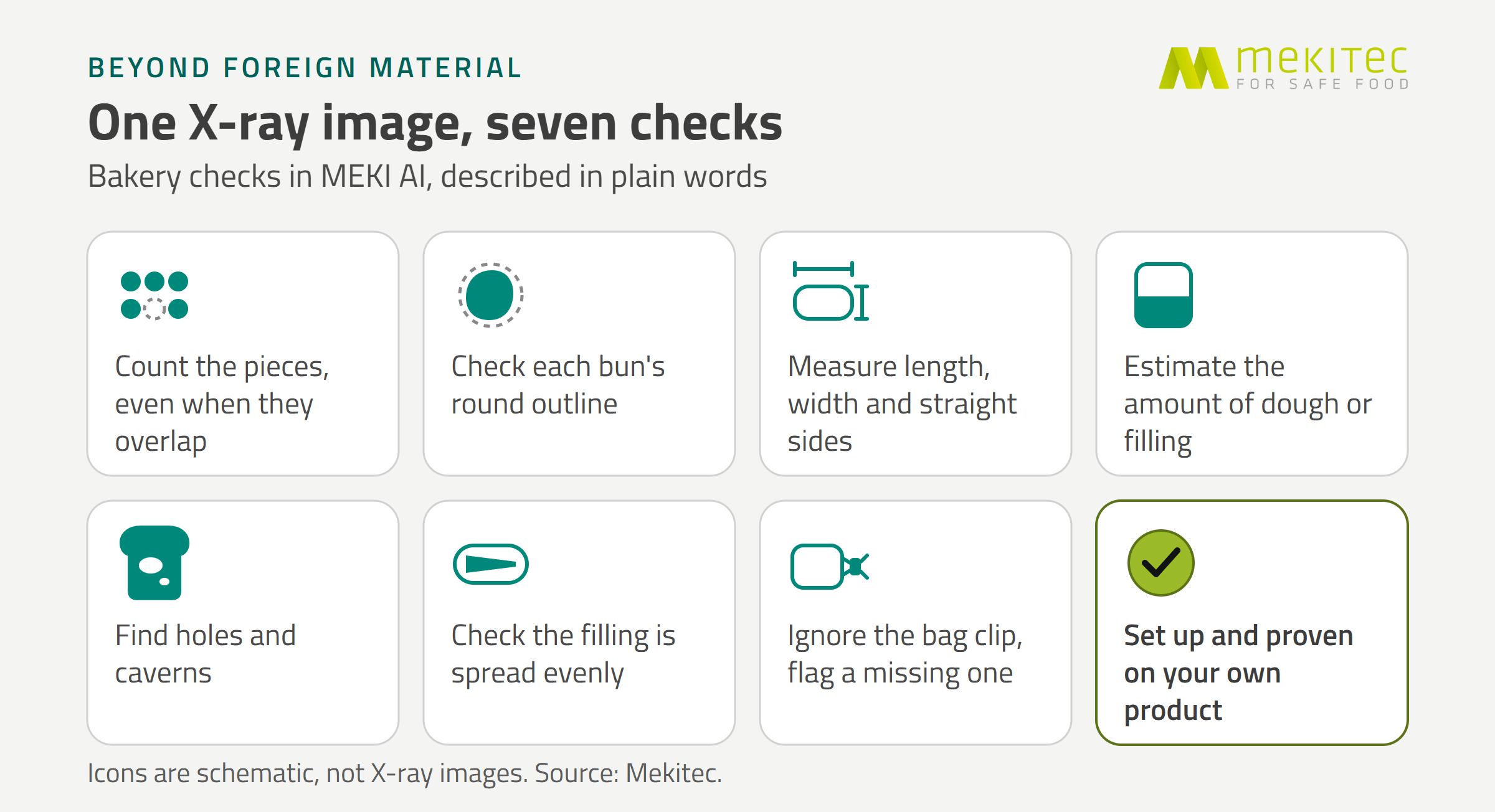
The IFS guideline lists counting components, finding missing or damaged products, and monitoring product shape and fill level among X-ray tasks. Holes are a real customer problem: Campden BRI found large fermentation holes in bread with in-line X-ray CT and noted that on sandwich lines such holes let mayonnaise seep through onto the conveyor (Campden BRI, 2020). At Verkade, the X-ray system removes biscuits with foreign objects and broken biscuits from the line.
MEKI AI, the inspection software on MEKI systems, can be set up for bakery checks that:
- count the pieces in a bag, even when they touch or overlap (Counter and Filling Inspection);
- check that each bun has the expected round outline;
- measure a loaf's length and width and how straight its sides are;
- estimate the total amount of dough or filling in a pack (missing product detection);
- find holes and caverns inside bread and pastries (cavern detection);
- check that a filling is spread evenly;
- ignore the clip that closes a bread bag while inspecting the rest, and flag a missing clip (products with a clip).
Each check is set up with the real product and proven on it. Normal bread has pores, so what counts as a defect is defined for each product, and some holes are too small or too thin to show.
Show us what you need to count or measure
Share the product, the pack and the defect you want to catch, so we can review the application and test it on your product.
Making it a control point you can prove
Where your hazard analysis makes the X-ray check a Critical Control Point, finding a fragment answers only the first of the five questions it has to answer: inspect, remove, prove, check and record. For a bakery line:
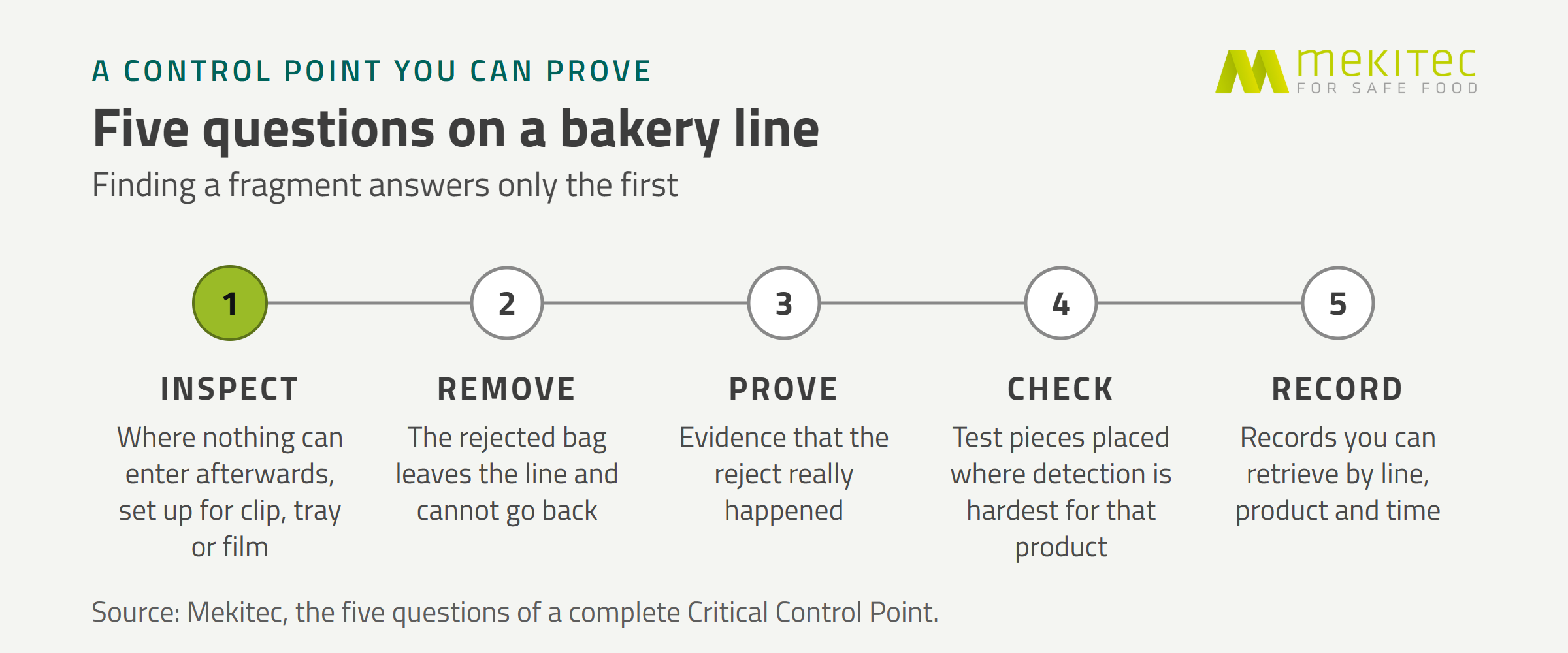
- Inspect: place the check where nothing can enter the product afterwards, and set it up for the clip, the tray or the film.
- Remove: make sure a rejected bag leaves the line and cannot be put back.
- Prove: have evidence that the reject actually happened, not only that it was commanded.
- Check: run routine checks with test pieces in a marked sample pack of the product, placed where detection is hardest, for example in the thickest part of a loaf and at the least sensitive height of the X-ray beam, at the frequency your plan and your customers set.
- Record: be able to retrieve the records for a given line, product and time window.
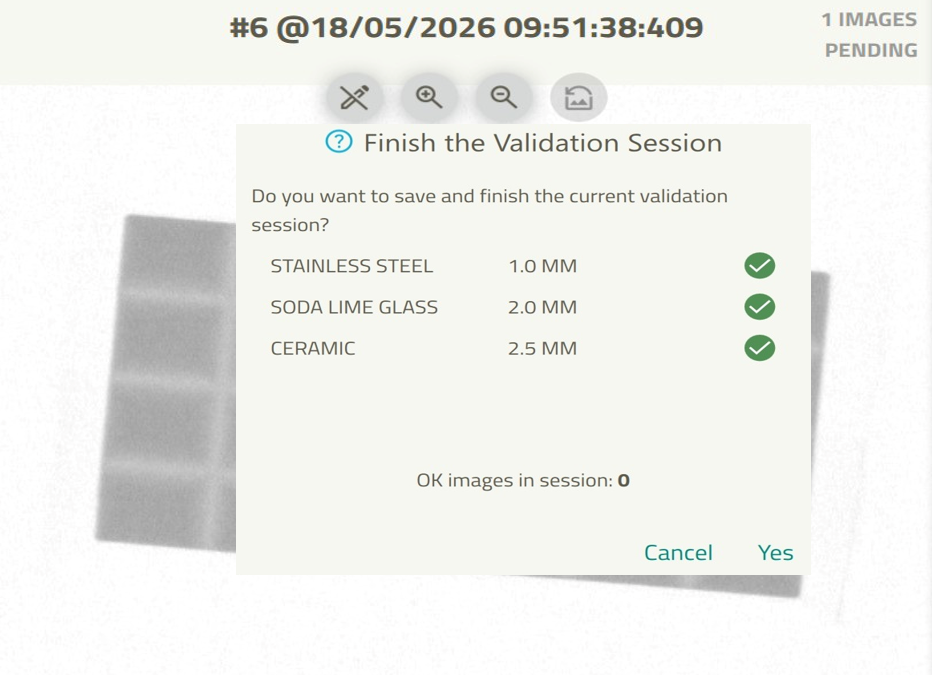
MEKI AI Validation Mode at the end of a routine check: all three test cards set for this product were found, and the session is saved with its X-ray images. The site chooses the test-piece sizes for each product; they are not detection limits for bread. Screen: Mekitec.
Our guides on what makes a Critical Control Point complete, the records to retrieve and switching from metal detection to X-ray go through each step.
Mekitec in bakery
- Systems: MEKI ONE for primary packaged foods such as packs of cookies, with inspection, automatic rejection, a reject bin and reject confirmation in one system. MIDMEKI for medium packages, multipacks and trays. WIDEMEKI for wide, low-profile packs such as bakery pillow packs, with published maximum product sizes (width x height) of 680 x 65 mm or 600 x 120 mm. The configuration is confirmed for each application.
- Bakery and biscuit references for X-ray inspection: City Baking, Snackwerks and Verkade.
- Team: Mekitec Latin America, our team in Mexico, developed AI inspection software for X-ray systems in industrial bakeries before it became part of Mekitec in 2021.
- Software: MEKI AI with the bakery checks above. MEKI AI Validation Mode schedules, enforces and records the site-defined routine CCP performance check; it does not replace complete application validation. MEKI Analytics helps QA review connected-system activity for the correct line, product and time window and prepare reporting from time-stamped evidence.
Test it on your own product
Detection and quality checks depend on the product and the pack, so the reliable answer comes from an application review and a product test. You do not need a finished specification to start. Tell us:
- which products and packs run on the line;
- which foreign materials are in your hazard analysis;
- what you want to count, measure or check;
- where on the line the check would sit.
Test your bread, buns or biscuits
Frequently asked questions
What foreign objects are most often found in bread and baked goods?
Metal and plastic. In the 86 US recalls of bakery products for foreign material from 2016 to 2025, metal was named in 33 and plastic in 27, followed by glass, rubber, wood and stone. In the EU's 94 RASFF notifications since 2020, metal is named in 46 and plastic in 23 (Mekitec bakery recall data).
Can X-ray find plastic, stone and glass in bread, or only metal?
Glass and stone, usually; plastic, only the dense kinds. Metal, glass, stone, bone and dense plastics such as PVC or PTFE absorb far more X-ray than bread and usually stand out. Light plastics such as polypropylene and polyethylene, like wood, paper and insects, absorb about as little as bread and usually do not show. Whether a given piece is found depends on its size, shape and position and on the product.
What can an X-ray system miss in baked goods?
Materials that are light or close in density to the product: wood, paper, soft and thin plastics, hair, insects and nutshells. Thin aluminium foil is usually not visible to X-ray at all. Preventive controls such as sieves, magnets, supplier approval and glass and plastics policies remain essential.
Is a metal detector enough for a bakery?
It can be, when the hazard analysis shows that metal is the relevant hazard and the product and pack suit metal detection. Warm, moist or salty products, foil trays and metallised film reduce metal-detector performance, and a metal detector does not find glass or stone. BRCGS and IFS do not require X-ray, while some retailers, Costco among them, ask for evidence that the chosen detector works best for the product.
Can X-ray find holes or missing filling inside bread and pastries?
Often, yes. A hole is less dense than the crumb around it, and missing filling changes the density of a filled product. Because normal bread has pores, what counts as a defect has to be defined for each product, and small or thin holes may not show. Test it with your own product.
Can an X-ray system count buns in a sealed bag?
Usually, yes. Counting and missing-product checks work through the bag, including when the pieces touch or overlap, once the check is set up and tested on that product. Buns squashed together or stacked can be hard to separate, so test with your own packs. IFS lists counting among the tasks of X-ray systems.
Do BRCGS or IFS require X-ray in a bakery?
No. BRCGS Food Safety Issue 9 expects metal detection unless a documented risk assessment justifies an alternative such as X-ray, and IFS Food version 8 has no requirement for a specific detector. BRCGS is preparing Issue 10, so confirm the current requirements with your certification body.
How often should a bakery X-ray system be checked?
As often as your HACCP plan and your customers require. Costco's audit expectations for suppliers (version 3.0), for example, ask for challenge tests at the start and end of each shift, at least every two hours, at batch and setting changes and after repairs. Place the test pieces where detection is hardest for that product.
Sources
- Mekitec, bakery recall data, US FDA and EU RASFF: US data to 28 October 2026, EU data to 9 November 2026.
- IFS, Guideline for an effective Foreign Body Management, version 3.
- North American Meat Institute and others, The Meat and Poultry Industry Foreign Material Manual, 2021.
- Morren et al., Effect of product microstructure and process parameters on modified atmosphere packaged bread, Food and Bioprocess Technology 10(2), 2017 (online 2016).
- Campden BRI, New technology to detect bread quality, 2020.
- US FDA, Hazard analysis and risk-based preventive controls for human food, draft guidance, chapter 3, 2018.
- US FDA, CPG Sec. 555.425, hard or sharp foreign objects.
- Costco, Global Food Safety Audit Expectations for Costco Suppliers, version 3.0, effective 1 September 2025.
- IFS Food, version 8, clause 4.12.4 (foreign material detection).
- Recall records cited: FDA Enforcement Reports F-1104-2014, F-1508-2023, F-0795-2024, F-0882-2024, F-0733-2025, H-0540-2026, H-0619-2026 and H-1244-2026; RASFF notifications 2025.4055 and 2026.0090.